|
Biography
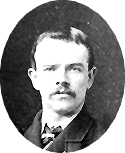
Patrick 'Yankee Pat'
Tinneny
Patrick Tinneny was born between 1856 and 1860 at
the Homeplace on Goladuff, Newtownbutler, County Fermanagh, Ireland
(Now Northern Ireland). He is said to be one of 14 children of John
"Big John" Tinneny and Margaret McAdam. His father's family was
from Goladuff and his mother was from Lambrock, which is also in
County Fermanagh. Goladuff is located in the southern part of the
County, north and across the border from County Cavan, which is in
the Irish Republic. Goladuff is in the Catholic Parish of Saint
Mary's, which is located in the town of Newtownbutler. Two of
Patrick's thirteen brothers and sisters were Francis and James.
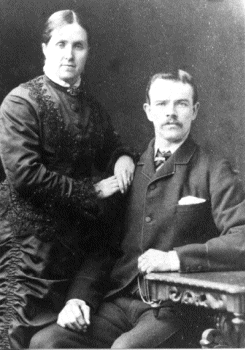
As a teenager, Patrick left the farm and his
family in Ireland. By 1876 he was living in Greenock, Scotland
where he worked in the Tate and Lyle sugar refinery. On June 1,
1876 he married Margaret Malloy. The couple was married by the
Reverend Alexander Taylor at Saint Mary's Catholic Church, 14
Patrick Street, Greenock, Scotland PA 16 8 NA. Witnesses to the
ceremony were his brother Francis Tinneny and Margaret McAnally.
Following their marriage they lived at 14 Shaw Street in Greenock.
A random search of the parish records at Saint Mary's for the period
1880-85 came up with entries showing the baptism of two of their 10
children, all of who were born in Greenock.
Photo: Patrick Tinneny and
Margaret Malloy - Courtesy of Richard Tinneny.
The first of these entries was for Mary Jane who
was baptized October 22, 1882. Her sponsors were Mary Jane Duncan
and James Malloy. The second entry was for Alice who was baptized
December 12, 1884. Her sponsor was Catherine Malloy. It should be
noted in both instances the name Malloy is spelled with an "o"
instead of an "a" and that in the entry for Mary Jane, Patrick's
name is spelled Tinney.
The 1891 Census of Greenock, Scotland, (Civil
parish and Municipal Burgh of Greenock, Burgh Ward VI) showed
Patrick and his family living at 14 East Shaw Street in Greenock
with their last name misspelled Tinney. The census lists Patrick as
the "Head of Household" and as a laborer in a sugar mill. His wife
Margaret is shown as being born in Renfrewshire, Scotland. The
couples children were listed on the census form as follows:
Catherine, age 14, Margaret 12, John 10, Mary Jane 8, Alice 6 and
Elizabeth 4 all identified with the occupation of scholar (students
in school). Finally James age 3 and Rose Ann 5 months, were listed.
Their immediate neighbors at the time the Census
was taken were Kenneth Davis, his wife May and their 5-month-old
daughter Jane. They also had two other Irish families as neighbors;
they were James O'Donnell, his wife Jane, son Matt and 14 year old
daughter Ellen. James was born in Ireland and was a boat builder.
Another neighbor, Thomas Grey, was also from Ireland. He and his
wife Catherine had two sons, Matthew and James and a daughter,
Lizzie.
In the late 1890's Patrick is said to have made
several trips to Philadelphia in America. In Philadelphia he worked
as a laborer building the massive stone retaining walls that now
stand along Main Street near Ridge Avenue in the Wissahicken section
of the city. He subsequently used the money he earned during these
trips to pay the passage for his wife and children to come to
America. According to his daughter Rose, it was because of these
trips to America that his friends back home in Scotland tagged him
with nickname "Yankee Pat".
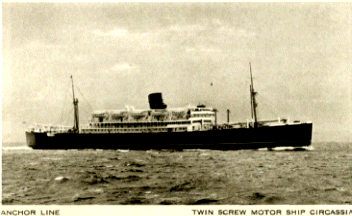
One of his pre immigration trips was aboard the
SS Circassia. The
ship list for that vessel dated March 7, 1892 shows Patrick arriving
in the port of New York.
 The list shows that he was 36 years old and
that he boarded the ship in Glasgow, Scotland and that his trade was labourer. The list shows that he was 36 years old and
that he boarded the ship in Glasgow, Scotland and that his trade was labourer.
The "Circassia" was built by Barrow Shipbuilding
Co, Barrow in 1878 for the Anchor Line. She was a 4,272 gross ton
ship, length 399.7ft x beam 42 ft, one funnel, three masts (rigged
for sail), iron construction, single screw and a speed of 13 knots.
There was passenger accommodation for 200-1st, 100-2nd and 800-3rd
class. She was the first North Atlantic liner to have refrigerated
space for meat and could carry 400 tons. Launched on 19th Mar.1878,
she sailed from Glasgow on her maiden voyage to Moville (N.Ireland)
and New York on 1st Jun.1878. She started her last voyage on 12th
Aug.1897 when she left Glasgow for Moville, New York and Glasgow and
was then laid up. In 1900 she was scrapped in Germany. North
Atlantic Seaway by N.R.P. Bonsor, vol.1, p.461]
[Merchant Fleets by Duncan Haws, vol.9,
Anchor Line]
In
addition to the money that Patrick was able to save, for the passage
of his family from Scotland, his daughter Rose understood that some
of the money was also loaned to him by his in-laws in Scotland.
Another account provided by his grand daughter Helen McKenna Gillard
said that he also may have borrowed some money for the passage from
his son-in-law Michael Sickinger as well as from his in-laws the
Dougherty's. At any rate, money allegedly loaned to Patrick for the
passage was to later become a source of a major rift between him and
his son-in-law Mike Sickinger.
Yankee Pat's final trip to America appears to
have been on June 14, 1900 when with $50.00 in his pocket, he left
Scotland for America. He traveled from Glascow to New York abroad
the steamship the S.S. State of Nebraska, which was a vessel of the
Allen ship line ANI. He traveled steerage, along with 23 other
passengers in that class. The nationalities of his fellow
passengers were diverse and included Austrians, Norwegians,
Russians, Scots, Finns and other Irishmen. It is noteworthy that
Patrick claimed Irish nationality on the ship's manifest even though
he had lived in Scotland all of his adult life.
 He
was 44 years old at the time of this voyage and listed his residence
as 17 East Shaw Street, Greenock, Scotland. His destination in
America was Philadelphia, Pennsylvania. The stated purpose of his
trip was to visit his daughter Mary Jane Tinneny at 125 Pensdale
Street, Manayunk, Philadelphia. Although the entry on the ship's
manifest indicates that this was his initial visit to America this
was probably not the case. The manifest further indicates that he
was married and a laborer by trade; that he could read and write,
had never been in prison or an almshouse nor had he been supported
by charity. Likewise, the ship's record shows that he was not a
polygamist, not under contract to work in the United States nor was
he crippled or deformed. His mental and physical health were listed
as good. He
was 44 years old at the time of this voyage and listed his residence
as 17 East Shaw Street, Greenock, Scotland. His destination in
America was Philadelphia, Pennsylvania. The stated purpose of his
trip was to visit his daughter Mary Jane Tinneny at 125 Pensdale
Street, Manayunk, Philadelphia. Although the entry on the ship's
manifest indicates that this was his initial visit to America this
was probably not the case. The manifest further indicates that he
was married and a laborer by trade; that he could read and write,
had never been in prison or an almshouse nor had he been supported
by charity. Likewise, the ship's record shows that he was not a
polygamist, not under contract to work in the United States nor was
he crippled or deformed. His mental and physical health were listed
as good.
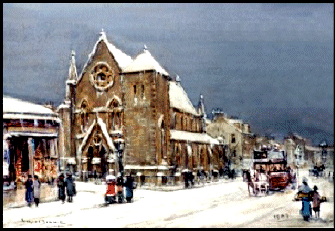
Photo: Saint Mary�s Catholic Church,
Greenock c.1887 The Parish of Yankee Pat and his Family.
From Saint Mary's Website.
The Christmas of 1900 must have been very
difficult for Patrick's wife Margaret and the six children that
remained with her in Greenock. Patrick had been away in America,
her oldest son John and daughters Mary Jane and Kate were with their
father in Philadelphia. In two days the family was to sail to
America, never to return to Scotland, their many Malloy relatives
and the burial place of their 13-month old son Francis who had died
just 9 months earlier.
On December 27th, Margaret and the six children,
Margaret, Alice, Elizabeth, James, Rose and Patrick left Glasgow
aboard the S.S. Sardinian. Passage for each of the children cost
$100.00. After experiencing a rough winter crossing they arrived at
the port of New York on Saturday, January 12, 1901.
|


